Lateral Epicondylitis (Tennis Elbow)
Anatomy
The elbow is a joint formed by three bones: the humerus in the upper arm, and the radius and ulna in the forearm. It allows two types of movement: bending and straightening the arm, and rotating the forearm to turn the palm up or down. The joint is stabilized by ligaments on both sides. On the inner side is the ulnar collateral ligament (UCL). On the outer side is the lateral collateral ligament (LCL).
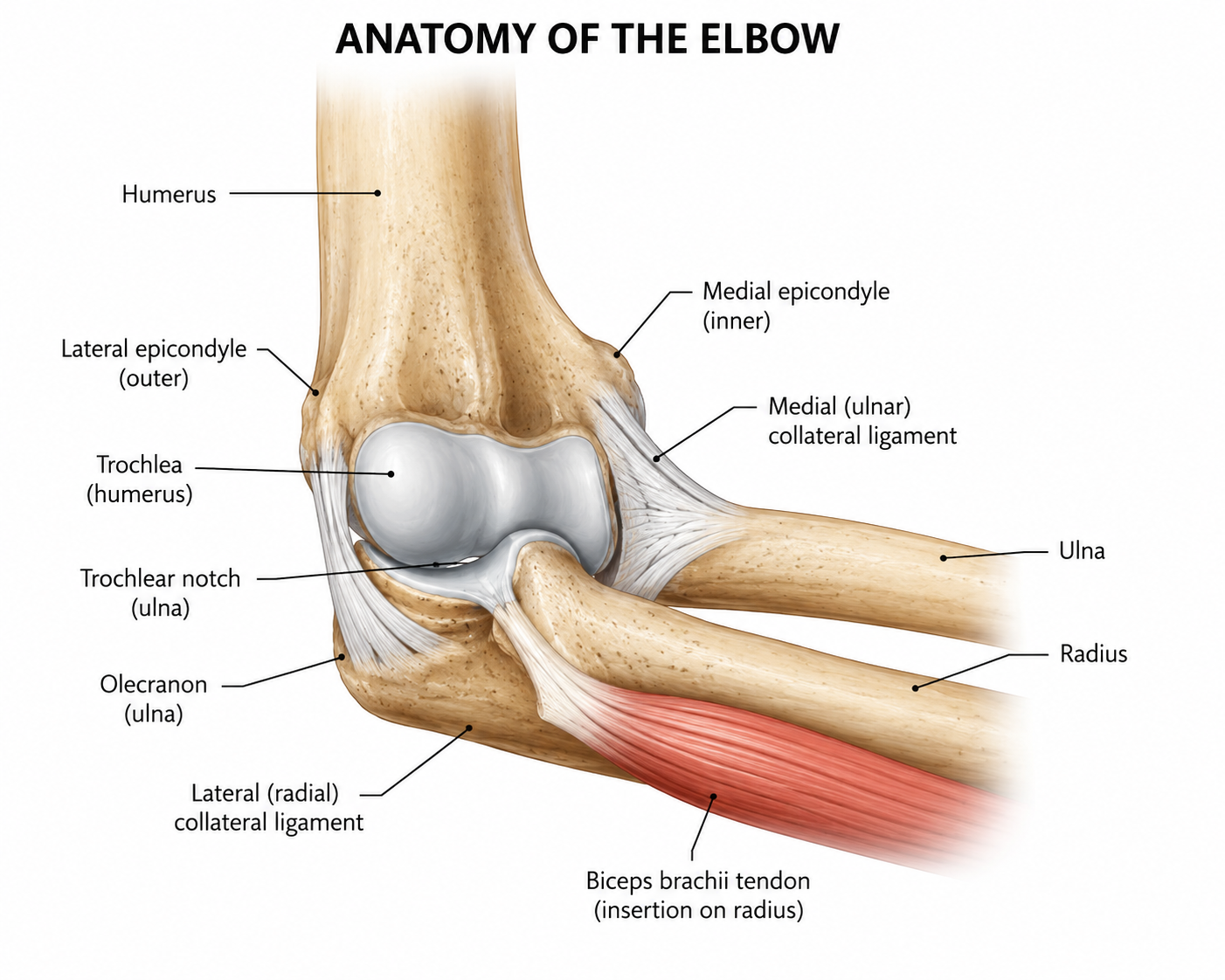
Several muscle groups cross the elbow. The biceps and brachialis bend the elbow, and the triceps straighten it. The forearm muscles that move the wrist and fingers also attach at the elbow, at bony points called the medial and lateral epicondyles. The medial epicondyle is on the inner side, where the ulnar nerve passes close to the surface. The lateral epicondyle is on the outer side, where the wrist extensor muscles attach.
What is Tennis Elbow?
Tennis elbow is a condition that causes pain and tenderness on the outer part of the elbow. Pain centers around the bony bump called the lateral epicondyle. Despite its name, it isn't limited to tennis players; it commonly affects anyone who performs repetitive motions involving the wrist and forearm.
The condition develops when the tendons that attach the forearm muscles to the lateral epicondyle become overloaded, typically from repetitive gripping, twisting, or extending motions of the wrist. Over time, this repeated stress causes tiny tears in the tendon fibers. The fiber tears lead to inflammation and degeneration of the tendon tissue, a process sometimes referred to as tendinosis when it becomes chronic.
Symptoms usually develop gradually rather than from a single injury, starting with mild soreness that can progress to persistent pain from the elbow down into the forearm. People with tennis elbow often notice weakness when gripping objects or lifting everyday items.
Treatment Options
Non-Operative Treatments
Activity Modification: Reducing or temporarily avoiding activities that aggravate symptoms can help decrease stress on the injured tendon and allow healing to occur.
Physical Therapy: A structured therapy program focuses on stretching and strengthening the wrist extensor muscles, particularly through eccentric exercises.
Anti-Inflammatory Medications: Over-the-counter nonsteroidal anti-inflammatory drugs (NSAIDs), such as ibuprofen or naproxen, may help reduce pain and inflammation during flare-ups.
Bracing or Counterforce Straps: Forearm straps and wrist braces can reduce the load placed on the extensor tendons during daily activities and sports, helping to relieve symptoms.
Corticosteroid Injections: Corticosteroid injections may provide short-term pain relief for some patients.
Platelet-Rich Plasma (PRP) Injections: PRP uses concentrated platelets from the patient's own blood and may stimulate tendon healing in cases of chronic lateral epicondylitis that have not improved with standard conservative treatments.
Gradual Return-to-Activity Program: Once symptoms improve, a progressive return to work program helps restore function.
Surgical Options
Open Debridement and Tendon Repair: The most commonly performed procedure for chronic tennis elbow. The surgeon removes degenerative tissue from the extensor carpi radialis brevis (ECRB) tendon and may repair or reattach healthy tendon to the lateral epicondyle.
Arthroscopic Debridement: Using a small camera and specialized instruments inserted through tiny incisions, the surgeon removes damaged tendon tissue while also evaluating the elbow joint for any additional damage. Arthroscopy typically results in smaller incisions and may allow for a faster recovery.
Percutaneous Tendon Release: A minimally invasive technique in which the damaged portion of the tendon is released or debrided through a small incision.
Extensor Tendon Repair or Reconstruction: In cases with significant tendon degeneration or tearing, the surgeon may repair the remaining healthy tendon or reconstruct the area using adjacent tissue to restore function and stability.
Dr. Tingstad specializes in lateral epicondylitis and will help you select the best treatment based on your injury.